This website is intended only for United States healthcare professionals; if you are not a United States healthcare professional, please visit www.BioMarin.com
This website was developed and funded by BioMarin and is intended for healthcare professionals only. It offers a non-exhaustive selection of materials, including but not limited to publications, presentations, posters and educational materials, to support scientific exchange.
Clinical study results reflect knowledge at the study’s completion and may not be current. Review the methodology, limitations, and authors’ financial disclosures for details.
The information on this website is not medical advice and should not replace independent medical judgment or further research. Content on investigational therapeutics or uses of approved products does not confirm safety or efficacy. BioMarin does not endorse off-label use of its medicines.
As product information may vary by country, please refer to your local health authority regulations and respective approved product information for indications and safety details.

State of Knowledge Summary

  • Alanine aminotransferase (ALT) elevations are a known adverse event of adeno-associated virus (AAV) gene therapy.1-3
  • Following valoctocogene roxaparvovec administration, the majority of patients experienced transient ALT elevations; some of which were temporally associated with a decrease in expression of the factor VIII (FVIII) transgene protein.4,5 The mechanism of these reactions is not yet fully understood.
  • ALT elevations (Grade 1-3) were generally rapidly responsive to corticosteroid treatment (or alternative immunosuppressants) with no symptoms or sequelae suggestive of clinically significant hepatocellular injury or liver dysfunction.4,5,7
  • Histopathological examination of liver biopsy samples retrieved up to 4 years after vector administration reveal no evidence of drug-induced liver injury.8

Additional Information

ALT Elevations

Study 270-201

  • ALT elevations were reported in 6 (85.7%) of 7 patients in the 6 x 10¹³ vg/kg cohort of Study 270-201.4 All were characterized as mild, nonserious, and transient; none were accompanied by cholestatic markers (alkaline phosphatase and bilirubin); and none met the criteria for Hy’s law.9
  • In Study 270-201, γ-glutamyltransferase enzyme levels were monitored as a sensitive indicator of hepatotoxicity and no safety signals emerged.9

GENEr8-1 (Study 270-301) 

  • Most patients in GENEr8-1 experienced ALT elevations meeting adverse event criteria.5
  • In GENEr8-1, adverse events of ALT elevation were initially defined as elevation ≥1.5x upper limit of normal (ULN) for directly enrolled patients.6 This was later amended to also include elevations greater than the ULN when ALT was also >2x baseline. For patients rolling over from Study 270-902, the definition was further expanded so that ALT greater than the ULN or ≥1.5x baseline qualified as an AE. Events meeting the threshold valid at the time of event are reported here as adverse events.
  • No Grade 4 or higher ALT elevations occurred in GENEr8-1.5,6,10-12
Image of ALT Elevations-Table

Liver Biopsies

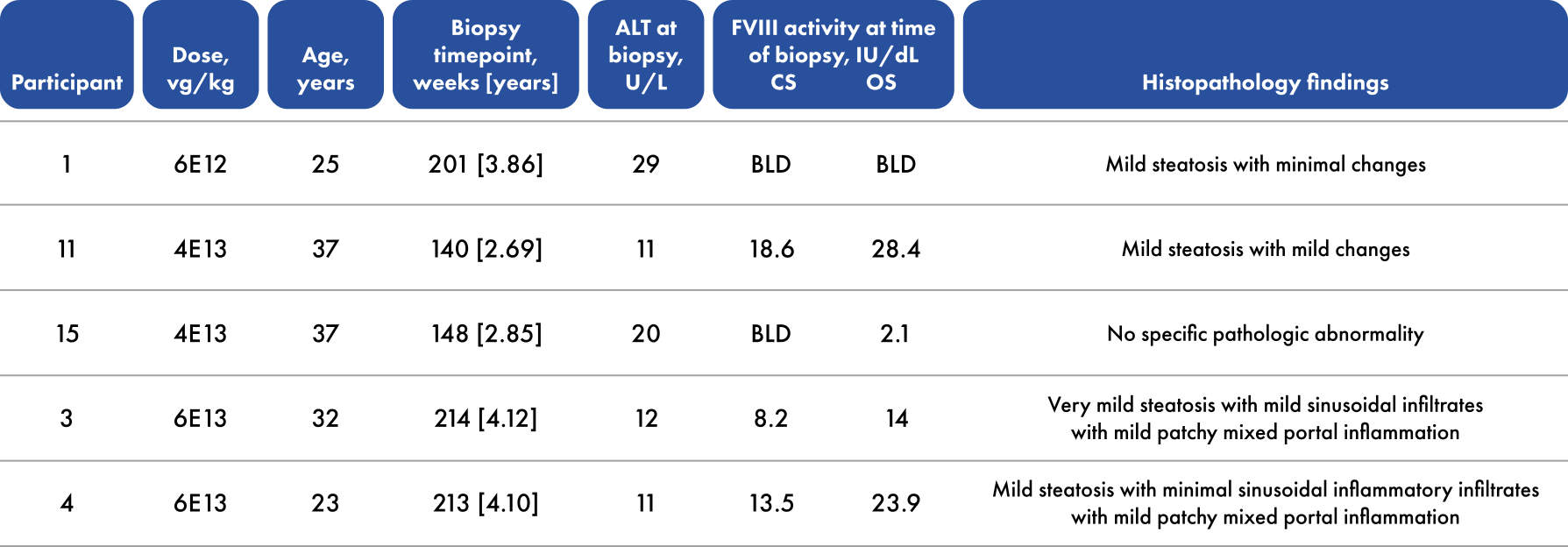
  • No clinically relevant hepatic issues were detected on histopathological examination of liver biopsy samples from all 5 recipients of valoctocogene roxaparvovec who agreed to participate in the liver biopsy sub-study of Study 270-201.8
  • There was no evidence of dysplasia, architectural distortion, fibrosis, or chronic inflammation, and no endoplasmic reticulum stress was detected in hepatocytes expressing hFVIII-SQ protein.8
  • Mild steatosis was observed in 4 of 5 patients but was considered to be representative of the expected high prevalence within normal male populations in developed countries.8
Table outlining liver biopsies

References:

  1. Monahan PE, Negrier C, Tarantino M, et al. Emerging Immunogenicity and Genotoxicity Considerations of Adeno-Associated Virus Vector Gene Therapy for Hemophilia. J Clin Med. 2021;10(11).
  2. Batty P, Lillicrap D. Hemophilia Gene Therapy: Approaching the First Licensed Product. Hemasphere. 2021;5(3):e540.
  3. Miesbach W, Foster GR, Peyvandi F. Liver-related aspects of gene therapy for hemophilia: need for collaborations with hepatologists. J Thromb Haemost. 2023;21(2):200-203.
  4. Rangarajan S, Walsh L, Lester W, et al. AAV5-Factor VIII Gene Transfer in Severe Hemophilia A. N Engl J Med. 2017;377(26):2519-2530.
  5. Ozelo MC, Mahlangu J, Pasi KJ, et al. Valoctocogene Roxaparvovec Gene Therapy for Hemophilia A. N Engl J Med. 2022;386(11):1013-1025.
  6. Mahlangu J, Kaczmarek R, von Drygalski A, et al. Two-Year Outcomes of Valoctocogene Roxaparvovec Therapy for Hemophilia A. N Engl J Med. 2023;388(8):694-705.
  7. Mahlangu J, von Drygalski A, Shapiro S, et al. Efficacy and safety of valoctocogene roxaparvovec gene transfer for severe hemophilia A: Results from the GENEr8-1 three-year analysis [presentation]. Presented at the Society of Thrombosis and Hemostasis Research (GTH) Annual Meeting. February 21-24, 2023; Frankfurt, Germany.
  8. Fong S, Yates B, Sihn CR, et al. Interindividual variability in transgene mRNA and protein production following adeno-associated virus gene therapy for hemophilia A. Nat Med. 2022;28(4):789-797.
  9. Pasi KJ, Rangarajan S, Mitchell N, et al. Multiyear Follow-up of AAV5-hFVIII-SQ Gene Therapy for Hemophilia A. N Engl J Med. 2020;382(1):29-40.
  10. Madan B, Ozelo MC, Raheja P, et al. Three-year outcomes of valoctocogene roxaparvovec gene therapy for hemophilia A. J Thromb Haemost. 2024;22(7):1880-1893.
  11. Leavitt AD, Mahlangu J, Raheja P, et al. Efficacy, safety, and quality of life 4 years after valoctocogene roxaparvovec gene transfer for severe hemophilia A in the phase 3 GENEr8-1 trial. Res Pract Thromb Haemost. 2024;8(8):102615.
  12. Leavitt AD, Mahlangu J, Raheja P, et al. Final GENEr8-1 results confirm enduring efficacy, safety, and quality of life improvements 5 years after valoctocogene roxaparvovec gene transfer [poster]. Presented at the International Society on Thrombosis and Haemostasis (ISTH) Congress. June 21-25, 2025; Washington, D.C.
  13. Symington E, Rangarajan S, Lester W, et al. Valoctocogene roxaparvovec gene therapy provides durable haemostatic control for up to 7 years for haemophilia A. Haemophilia. 2024;30(5):1138-1147.