This website is intended only for United States healthcare professionals; if you are not a United States healthcare professional, please visit www.BioMarin.com
This website was developed and funded by BioMarin and is intended for healthcare professionals only. It offers a non-exhaustive selection of materials, including but not limited to publications, presentations, posters and educational materials, to support scientific exchange.
Clinical study results reflect knowledge at the study’s completion and may not be current. Review the methodology, limitations, and authors’ financial disclosures for details.
The information on this website is not medical advice and should not replace independent medical judgment or further research. Content on investigational therapeutics or uses of approved products does not confirm safety or efficacy. BioMarin does not endorse off-label use of its medicines.
As product information may vary by country, please refer to your local health authority regulations and respective approved product information for indications and safety details.

Malignancy (vector integration)

State of Knowledge Summary

  • Integration with theoretical risk of associated adverse events remains a safety concern with adeno-associated virus (AAV) gene therapies.1,2
  • To date, there is no evidence to suggest that AAV gene therapy directly causes cancer. However, there are risks associated with AAV gene therapy, and long-term safety data are still being collected.3
  • To date, no treatment-related events attributed to vector integration have been observed with valoctocogene roxaparvovec or analogs.4-9
  • No cases of malignancy reported in valoctocogene roxaparvovec clinical trials have been determined to be related to treatment with valoctocogene roxaparvovec.6,8
  • The clinical relevance of individual vector insertional events is not known to date.3,12
  • While AAV vector DNA integration has been observed in humans, non-human primates (NHPs), and dogs, there have been no reports of resulting genotoxicity or oncogenesis.13-15
  • Overall, while the long-term safety of AAV gene therapy is still being evaluated, there is currently no evidence to suggest that AAV gene therapy directly causes cancer.16

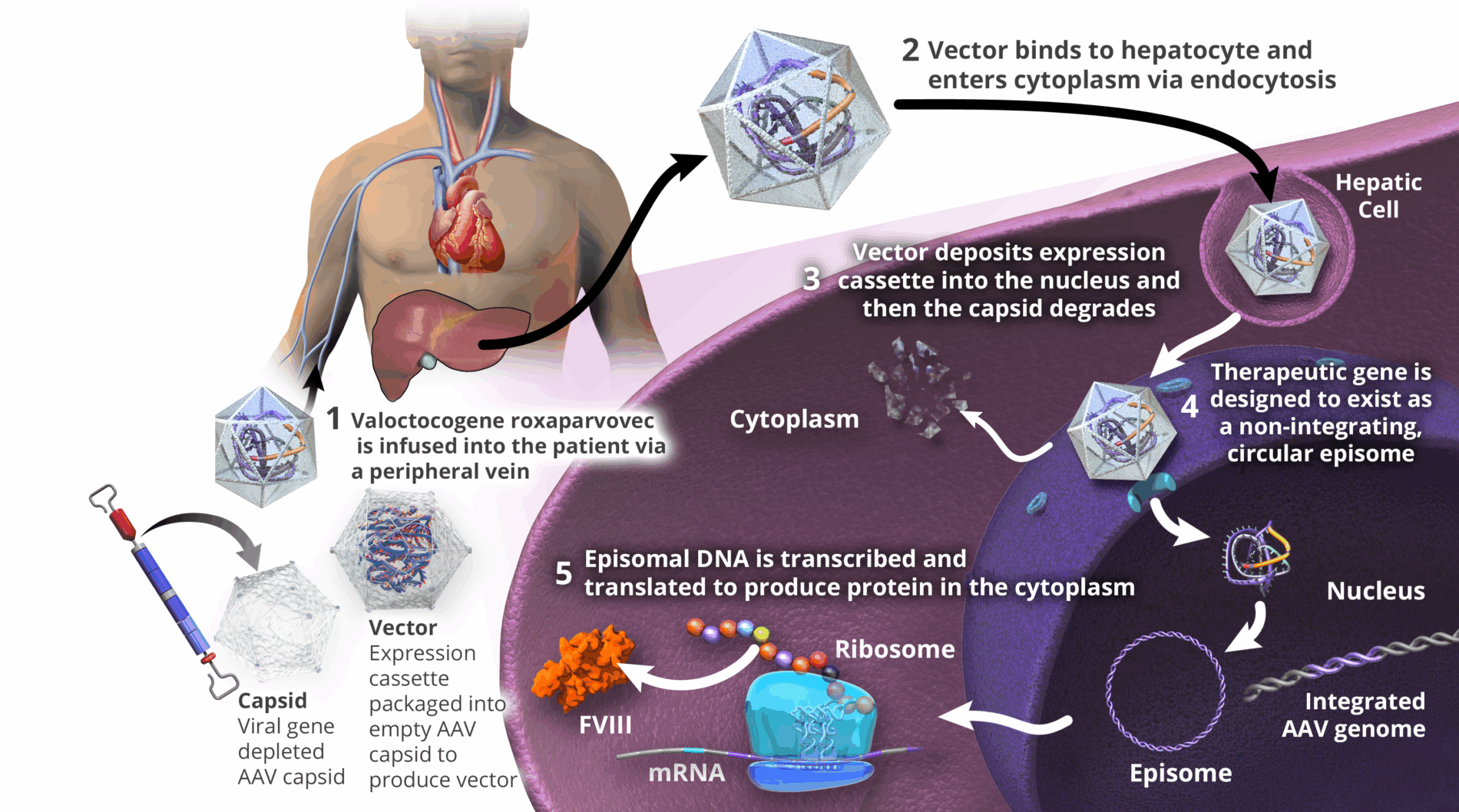
Valoctocogene roxaparvovec is designed to deliver therapeutic transgene to the hepatocyte nucleus, where it is expected to persist as extra-chromosomal episomes; however, valoctocogene roxaparvovec can insert into the DNA of human body cells.7,17,18 The clinical relevance of individual vector insertional events is not known to date.

Graphic outlining malignancy
  • BioMarin has performed integration analyses on non-human primates samples, liver samples from clinical trial patients, healthy and tumor-containing tissue from a trial patient with a parotid gland acinar cell carcinoma, and enriched bone marrow cells and peripheral blood lymphoblasts from a trial patient with B-cell acute lymphoblastic leukemia.17-19
    • Across these analyses, the rate of integration for valoctocogene roxaparvovec was low and comparable on a per cell basis to those exposed with natural AAV, where no epidemiological risk has been identified.18,20
    • No clonal expansion or uneven growth of cells containing integration events was observed in any of the samples analyzed.18
  • No cancers determined to be caused by valoctocogene roxaparvovec have been observed in any clinical trials and no cancers have been observed in non-clinical studies with valoctocogene roxaparvovec.6,8,19

You may report adverse events to BioMarin at drugsafety@bmrn.com. You are encouraged to report negative adverse events of prescription drugs to the FDA. Visit www.fda.gov/medwatch, or call 1-800-FDA-1088.

References:

  1. European Medicines Agency (EMA). Reflection paper on management of clinical risks deriving from insertional mutagenesis. EMA Committee for Advanced Therapies (CAT). 19 April 2013.
  2. Sabatino DE, et al. Evaluating the state of science for AAV integration: An integrated perspective. Mol Ther. 2022;30(8):2646-63
  3. Burdett T and Nuseibach S. Changing trends in the development of AAV-based gene therapies: a meta-analysis of past and present therapies. Gene Ther. 2023;30:323-335.
  4. Rangarajan S, Walsh L, Lester W, et al. AAV5-Factor VIII Gene Transfer in Severe Hemophilia A. N Engl J Med. 2017;377(26):2519-2530.
  5. Ozelo MC, Mahlangu J, Pasi KJ, et al. Valoctocogene Roxaparvovec Gene Therapy for Hemophilia A. N Engl J Med. 2022;386(11):1013-1025.
  6. Mahlangu J, Leavitt AD, Raheja P, et al. Efficacy and safety of valoctocogene roxaparvovec for severe hemophilia A 5 years after gene transfer in GENEr8-1 [presentation]. Presented at the World Federation of Hemophilia Comprehensive Care Summit (WFH-CCS). April 23-25, 2025; Dubai, United Arab Emirates.
  7. Pasi KJ, Rangarajan S, Mitchell N, et al. Multiyear Follow-up of AAV5-hFVIII-SQ Gene Therapy for Hemophilia A. N Engl J Med. 2020;382(1):29-40.
  8. Laffan M, Rangarajan S, Lester W, et al. Hemostatic results for up to 6 years following treatment with valoctocogene roxaparvovec, an AAV5-hFVIII-SQ gene therapy for severe hemophilia A [presentation]. Presented at the International Society on Thrombosis and Haemostasis (ISTH) Congress. July 9-13, 2022; London, United Kingdom.
  9. BioMarin Press Release, January 2023
  10. Kuzmin DA, Shutova MV, Johnston NR, et al. The clinical landscape for AAV gene therapies. Nat Rev Drug Discov. 2021;20(3):173-174.
  11. Mullard A. Gene therapy community grapples with toxicity issues, as pipeline matures. Nat Rev Drug Discov. 2021;20(11):804-805.
  12. Kishimoto TK and Samulski RJ. Addressing high dose AAV toxicity – ‘one and done’ or ‘slower and lower’? Expert Opinion on Biol Ther. 2022;22(9):1067-71.
  13. Gil-Farina I, Fronza R, Kaeppel C, et al. Recombinant AAV Integration Is Not Associated With Hepatic Genotoxicity in Nonhuman Primates and Patients. Mol Ther. 2016;24(6):1100-1105.
  14. Batty P, Fong S, Franco M, et al. Frequency, location and nature of AAV vector insertions after long term follow up of FVIII transgene delivery in a hemophilia A dog model [poster]. Presented at the International Society on Thrombosis and Haemostasis (ISTH) Virtural Congress. July 12-14, 2020.
  15. Nguyen GN, Everett JK, Kafle S, et al. A long-term study of AAV gene therapy in dogs with hemophilia A identifies clonal expansions of transduced liver cells. Nat Biotechnol. 2021;39(1):47-55.
  16. Mary Ann Liebert, Inc. Does AAV-based gene delivery cause liver cancer? The debate heats up. 26 May 2016. Medical Xpress.
  17. Fong S, Yates B, Sihn CR, et al. Interindividual variability in transgene mRNA and protein production following adeno-associated virus gene therapy for hemophilia A. Nat Med. 2022;28(4):789-797.
  18. Eggan K. Molecular Characterization of FVIII Recombinant AAV5 encoding FVIII after Human administration [presentation]. Presented at the Annual Meeting of the European Society of Gene & Cell Therapy (ESGCT). October 11-14, 2022; Edinburgh, UK.
  19. Sullivan L, Zahn M, Gil Farina I, et al. Rare Genomic Integrations of AAV5-hFVIII-SQ Occur without Evidence of Clonal Activation or Gene-Specific Targeting [poster]. Presented at the American Society of Gene and Cell Therapy (ASGCT) Annual Meeting. May 11-May 14, 2021.
  20. Qin W, Xu G, Tai PWL, et al. Large-scale molecular epidemiological analysis of AAV in a cancer patient population. Oncogene. 2021;40(17):3060-3071.